
ISEK 2026 Program
June 24-27
The 2026 Program will include a line-up of internationally renowned keynote speakers, along with other components such as pre-congress workshops on key topics, as well as a series of oral and poster presentations.
The Congress will be held at the Paviljonki event centre.
Located in the heart of Jyväskylä, Finland, Paviljonki is one of the country’s premier venues for conferences, exhibitions, and cultural events. The centre features modern, flexible spaces that can host everything from large-scale trade fairs to intimate meetings. With excellent acoustics, state-of-the-art technology, and a central location just steps from hotels, restaurants, and transport links, Paviljonki offers a convenient and welcoming setting for attendees.
Possible travel disruption for presenters
Dear colleagues,
I wanted to acknowledge the current events affecting multiple regions around the world, and the uncertainty and distress this is creating for many members of our community and beyond. We recognise that some colleagues are dealing with immediate personal, family, institutional, and travel-related challenges.
Our ISEK community remains committed to our in-person congress in Jyväskylä, Finland, on June 24–27, 2026. We sent notifications regarding submitted abstracts last week and intend to open a call for late-breaking abstracts, that may be accepted for a poster presentation from 24-27 June.
We understand that the current situation may make it difficult for some presenters to make an immediate decision about travel in June and ask you to please contact us directly if your attendance as a presenter is uncertain.
The registration dates published on the ISEK website remain in place, with early-bird registration open until April 25 and regular registration until June 4.
Thank you for your continued engagement with the ISEK.
Warm regards,
Professor Kylie Tucker,
ISEK President, on behalf of the ISEK council and ISEK2026 congress conveners.
Quick links
ISEK 20206 Program Schedule
Please note: the program schedule is subject to change until all oral presentations are confirmed.
Click on the program below to review:
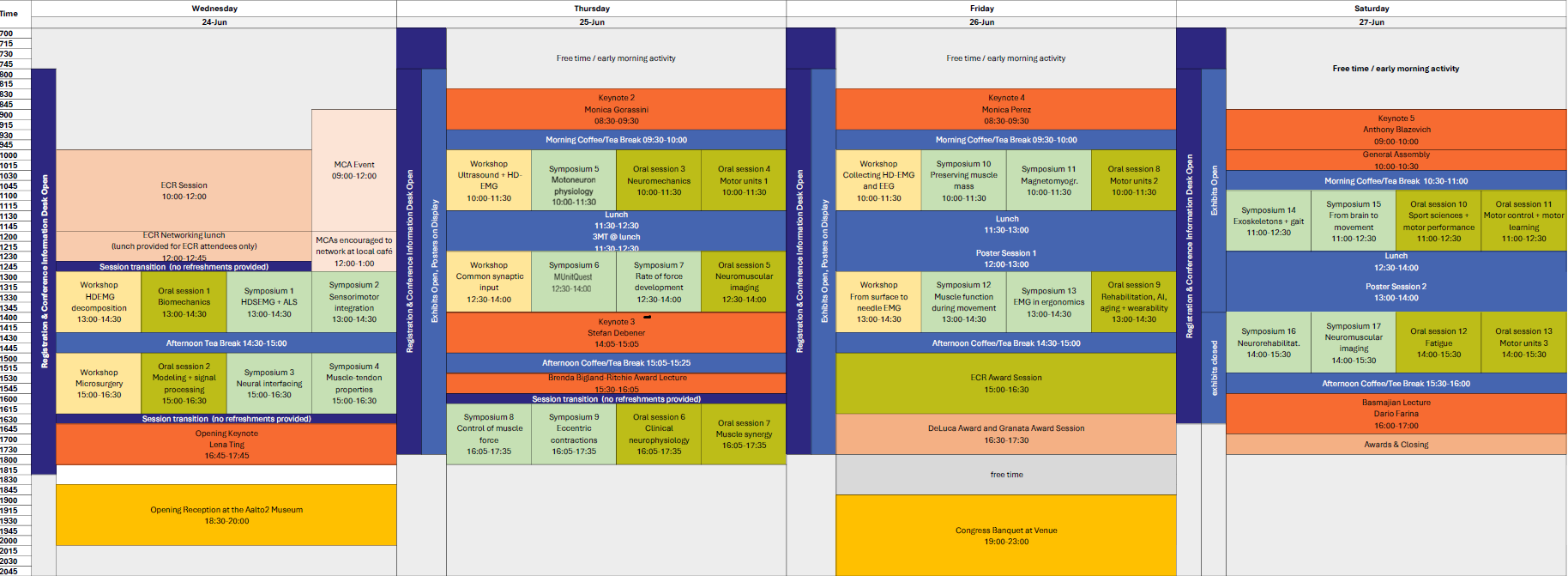
ISEK 2026 detailed program
08:30 – Registration / badge pick-up open
09:00 – 12:00 MCA event – Personal value workshop for mid-career academics
10:00 – 12:00 ECR session
12:00 – 12:45 ECR networking lunch (lunch provided for participants only)
12:45 – 13:00 Transition break (no refreshments provided at this time)
Parallel sessions:
13:00 – 14:30 Workshop 1: HDEMG decomposition for deciphering the neural codes in the spinal cord and brain: from theory to practice
13:00 – 14:30 Oral 1: Biomechanics
13:00 – 14:30 Symposium 1: How HDSEMG is propelling ALS biomarker research forward
13:00 – 14:30 Symposium 2: Impact of altered sensory inputs on sensorimotor integration-from reflexes to cortical connectivity
14:30 – 15:00 Tea/coffee break
Parallel sessions:
15:00 – 16:30 Workshop 2: Fine sensorimotor control, skill, and learning in the context of microsurgery
15:00 – 16:30 Oral 2: Modelling and signal processing
15:00 – 16:30 Symposium 3: Modern EMG technologies for understanding the neural control of movement and for neural interfacing
15:00 – 16:30 Symposium 4: From the outside to the inside: inferring altered muscle-tendon properties and structure from kinematics, kinetics and electromyography
16:30 – 16:45 Transition break (no refreshments provided at this time)
16:45 – 17:45 Keynote: Lena Ting
17:45 – 18:15 Short walk to the Aalto Museum
18:15 – 20:15 Welcome reception @ the Aalto Museum
08:00 – 16:00 Registration / badge pick-up open
08:30 – 09:30 Keynote: Monica Gorassini
09:30 – 10:00 Coffee break
Parallel sessions:
10:00 – 11:30 Workshop 3: Hands-on muscle neuromechanics: Practical integration of ultrasound and HD-EMG
10:00 – 11:30 Symposium 5: International Motoneuron Society Symposium: motoneuron physiology in people with motor impairment
10:00 – 11:30 Oral 3: Neuromechanics
10:00 – 11:30 Oral 4: Motor units 1
11:30 – 12:30 Lunch & 3MT session
Parallel sessions:
12:30 – 14:00 Workshop 4: From HDsEMG-based motor unit identification to coherence analysis: How to estimate the common synaptic input to spinal motor neurons
12:30 – 14:00 Symposium 6: MUnitQuest: Towards open, transparent, and reproducible validation of motor unit identification
12:30 – 14:00 Symposium 7: Is rate of force development (RFD) really ‘functionally relevant’ (and if so, which RFD and for whom)?
12:30 – 14:00 Oral 5: Neuromuscular imaging
14:00 – 14:05 Transition break (no refreshments provided at this time)
14:05 – 15:05 Keynote: Stefan Debener
15:05- 15:25 Tea/coffee break
15:30 – 16:05 Brenda Bigland-Ritchie Award Lecture
Parallel sessions:
16:05 – 17:35 Symposium 8: Control of muscle force by the distribution of shared synaptic inputs within and across pools of motor units
16:05 – 17:35 Symposium 9: Strain and shear in eccentric contractions: Injury and injury prevention
16:05 – 17:35 Oral 6: Clinical neurophysiology
16:05 – 17:35 Oral 7: Muscle synergy
19:00 – 22:00 ECR Nightless Night with ReC Bioengineering Laboratories, Finlandia Hotel Alba, Ahlmaninkatu 4

-End of day
08:00 – 16:15 Registration / badge pick-up open
08:30 – 09:30 Keynote: Monica Perez
09:30 – 10:00 Tea/coffee break
Parallel sessions:
10:00 – 11:30 Workshop 6: Collecting HD-EMG and EEG signals in challenging conditions: Principles, engineering, and practical solutions for high-quality signal detection
10:00 – 11:30 Symposium 10: Preserving skeletal muscle mass and function during disuse: the power of neuromuscular electrical stimulation (NMES)
10:00 – 11:30 Symposium 11: Magnetomyography, a contactless alternative to EMG using quantum sensors
10:00 – 11:30 Oral 8: Motor units 2
11:30 – 13:00 Lunch
12:00 – 13:00 Poster session 1
Parallel sessions:
13:00 – 14:30 Workshop 5: From surface to needle EMG: Confronting the gap between research and clinical practice
13:00 – 14:30 Symposium 12: Assessing muscle function during movement – challenges and perspectives from electrophysiology and ultrasound imaging
13:00 – 14:20 Symposium 13: Surface electromyography in ergonomics. Past, present and future applications
13:00 – 14:30 Oral 9: Rehabilitation, AI, aging & wearables
14:30 – 15:00 Tea/coffee break
15:00 – 16:30 ECR Awards session
16:30 – 17:30 Awards session
19:00 – 23:00 Congress banquet
-End of day
08:30 – 16:00 Registration / badge pick-up open
09:00 – 10:00 Keynote: Anthony Blazevich
10:00 – 10:30 General Assembly
10:30 – 11:00 Tea/coffee break
Parallel sessions:
11:00 – 12:30 Symposium 14: Exoskeletons in gait assistance: Opportunities, challenges, and future directions
11:00 – 12:30 Symposium 15: From brain to movement: Normal trunk motor control and motor adaptations in clinical populations
11:00 – 12:30 Oral 10: Sport sciences and motor performance
11:00 – 12:30 Oral 11: Motor control and motor learning
12:30 – 14:00 Lunch
13:00 – 14:00 Poster session 2
Parallel sessions:
14:00 – 15:30 Symposium 16: Closed-loop neurorehabilitation across the lifespan: From motoneurons to movement
14:00 – 15:30 Symposium 17: Advanced neuromuscular imaging: insights into muscle quality
14:00 – 15:30 Oral 12: Fatigue
14:00 – 15:30 Oral 13: Motor units 3
15:30 – 16:00 Tea/coffee break
16:00 – 17:00 Keynote: Dario Farina
17:00 – 17:30 Awards session
-End of Conference
Submitted Sessions
Confirmed Symposium Sessions (click to open)
Symposium 1: How HDSEMG is propelling ALS biomarker research forward
James Bashford 1, Jakob Škarabot 2, Anna Carobin 1, Giuseppina Del Duca 3, Zuyu Du 3
1 King’s College London, 2 Loughborough University, 3 Trinity College Dublin
Symposium 2: Impact of altered sensory inputs on sensorimotor integration-from reflexes to cortical connectivity
Bernadette Murphy 1, Kemal Türker 2, Hailey Tabbert 3, Heidi Haavik 4, Imran Khan Niazi 4
1 Ontario Tech University, 2 İstanbul Gelişim Üniversitesi, 3 Ontario Tech Univeristy, 4 New Zealand College of Chiropractic
Symposium 3: Modern EMG technologies for understanding the neural control of movement and for neural interfacing
Vishal Rawji 1, Ciara Gibbs 1, Agnese Grison 1, Jaime Ibañez Pereda 2
1 Imperial College London, 2 BSICoS Group, I3A, University of Zaragoza
Symposium 4: From the outside to the inside: inferring altered muscle-tendon properties and structure from kinematics, kinetics and electromyography
Francesco Cenni 1, Ursula Trinler 2, Hans Kainz 3, Kenneth Meijer 4, Simon-Henri Schless 5, Nathalie Alexander 6
1 University of Jyväskylä, 2 Head of Motion Analysis Laboratory, BG Klinik Ludwigshafen, Germany, 3 University of Vienna, 4 Maastricht University, 5 Tel Aviv University, 6 Laboratory for Motion Analysis, Children’s Hospital of Eastern Switzerland, St. Gallen, Switzerland
Symposium 5: International Motoneuron Society Symposium: motoneuron physiology in people with motor impairment
Greg Pearcey 1, Francesco Negro 2, Allison Hyngstrom 3, Laura McPherson 4, 5, Alex Benedetto 6, Eduardo Martinez-Valdes 7, James Beauchamp 8
1 Memorial University of Newfoundland, 2 Università degli Studi di Brescia, 3 Marquette University, 4 Florida International University, 5 Washington University in St. Louis, 6 Northwestern University, 7 University of Birmingham, 8 Carnegie Mellon University
Symposium 6: MUnitQuest: Towards open, transparent, and reproducible validation of motor unit identification
Thomas Klotz 1, Robin Rohlén 2, Oliver Röhrle 1, Dario Farina 2, Pranav Mamidanna 2, Paul Hodges 3, Seyed Yahya Shirazi 4
1 University of Stuttgart, 2 Imperial College London, 3 The University of Queensland, 4 University of California San Diego
Symposium 7: Is rate of force development (RFD) really ‘functionally relevant’ (and if so, which RFD and for whom)?
Nicola Maffiuletti 1, Gennaro Boccia 2, Luca Ruggiero 3, Per Aagaard 4
1 Schulthess Clinic, 2 University of Turin, 3 University of Konstanz, 4 University of Southern Denmark (Denmark)
Symposium 8: Control of muscle force by the distribution of shared synaptic inputs within and across pools of motor units
Roger Enoka 1, Marius Osswald 2, Dylan Carter 3, Nikos Varvariotis 4
1 University of Colorado Boulder, 2 Friedrich-Alexander-Universität Erlangen-Nürnberg, 3 Imperial College London, 4 Aristotle University of Thessaloniki at Serres
Symposium 9: Strain and shear in eccentric contractions: Injury and injury prevention
Kazunori Nosaka 1, Anthony Blazevich 1, Taija Finni 2
1 Edith Cowan University, 2 University of Jyväskylä
Symposium 10: Preserving skeletal muscle mass and function during disuse: the power of neuromuscular electrical stimulation (NMES)
Marlou Dirks 1, Chris Mcneil 2, Nicola Maffiuletti 3, Barbara Tempert-De Haan 4
1 Wageningen University, 2 University of British Columbia, Okanagan, 3 Schulthess Clinic, 4 Medisch Spectrum Twente
Symposium 11: Magnetomyography, a contactless alternative to EMG using quantum sensors
Joonas Iivanainen 1, Justus Marquetand 2, Thomas Klotz 3, Tai Otani 4, Stefan Hartwig 5
1 Aalto University, 2 University of Tübingen, 3 University of Stuttgart, 4 Institute of Science Tokyo, 5 Physikalisch-Technische Bundesanstalt Berlin, Berlin, Germany
Symposium 12: Assessing muscle function during movement – challenges and perspectives from electrophysiology and ultrasound imaging
Anderson Oliveira 1, Walter Herzog 2, Alberto Botter 3, Francesco Cenni 4, Brent Raiteri 5
1 Aalborg University, 2 University of Calgary, 3 Politecnico di Torino, 4 University of Jyväskylä, 5 Ruhr University Bochum
Symposium 13: Surface electromyography in Ergonomics. Past, Present and Future Applications
Pascal Madeleine 1, Benjamin Steinhilber 2, 3, Tessy Luger 3, Markus Koch 4, Benjamin Steinhilber 5, Karen Søgaard 6
1 Aalborg University, 2 University Hospital Tuebingen, 3 Eberhard Karls University and University Hospital of Tübingen, 4 National Institute of Occupational Health, 5 Eberhard Karls University and University Hospital of Tübingen, 6 University of Southern Denmark
Symposium 14: Exoskeletons in Gait Assistance: Opportunities, Challenges, and Future Directions
Juha-Pekka Kulmala 1, Ivan Vujaklija 2, Maxwell Thurston 3, Mika Peltoniemi 3, Madalina Moscu 2
1 Helsinki University Hospital, 2 Aalto University, 3 Faculty of Sport Sciences, University of Jyväskylä
Symposium 15: From Brain to Movement: Normal Trunk Motor Control and Motor Adaptations in Clinical Populations
Hugo Massé-Alarie 1, Shin-Yi Chloe Chiou 2, Paul Strutton 3, Mikaël Desmons 4, Christoph Bauer 5
1 Cirris – Université Laval, 2 University of Birmingham, 3 Imperial College London, 4 Université Limoges, 5 University Lucerne
Symposium 16: Closed-Loop Neurorehabilitation Across the Lifespan: From Motoneurons to Movement
Alessandro Del Vecchio 1, Jaime Ibañez Pereda 2, Andrea Casolo 3, Raul Sîmpetru 1, Pauline Wittermann 1, 4, Marcos Sacristán 5, Blanca Delgado 5
1 Friedrich-Alexander Universität, Erlangen-Nürnberg, 2 BSICoS Group, I3A, University of Zaragoza, 3 University of Padua, 4 FAU Erlangen-Nuremberg, 5 University of Zaragoza
Symposium 17: Advanced neuromuscular imaging: insights into muscle quality
Francesco Cenni 1, Melissa Hooijmans 2, Patricio Pincheira 3, Kaat Desloovere 4, Ruoli Wang 5, Zhongzheng Wang 6
1 University of Jyväskylä, 2 Department of Human Movement Sciences, VU Amsterdam, Amsterdam, The Netherlands, 3 The University of Southern Queensland, 4 Katholieke Universiteit Leuven, 5 KTH MoveAbility, Department of Engineering Mechanics, KTH Royal Institute of Technology, Stockholm, 6 KTH Royal Institute of Technology
ISEK 2026 has the potential to deliver great advances in understanding of human movement and meaningful clinical impact. The multidisciplinary nature of ISEK provides the perfect environment to bring together these different perspectives united under the common goal of increasing understanding of human movement.
The 2026 Congress will adhere to the traditional format and will feature keynote lectures from distinguished international guest speakers. Most importantly, we will be presenting research contributed by our members. The Congress will feature workshops, symposium, individual oral presentations grouped by themes as well as posters.
The ISEK Congress was supported in part by the National Center for Medical Rehabilitation Research within the National Institutes of Health under award number HD115388.
The content is solely the responsibility of ISEK and does not necessarily represent the official views of the National Institutes of Health.
Submissions themes:
Aging
AI, Data Fusion, and Machine Learning
Biomechanics
Brain Imaging
Clinical Neurophysiology
Electrical Myostimulation
Fatigue
Modelling and Signal Processing
Motor Control and Motor Learning
Motor Disorders
Motor Units
Muscle Synergy
Neuromechanics
Neuromuscular Imaging
Pain
Rehabilitation
Robotic Rehabilitation
Sports Sciences and Motor Performance
Wearable Sensors and IoT